
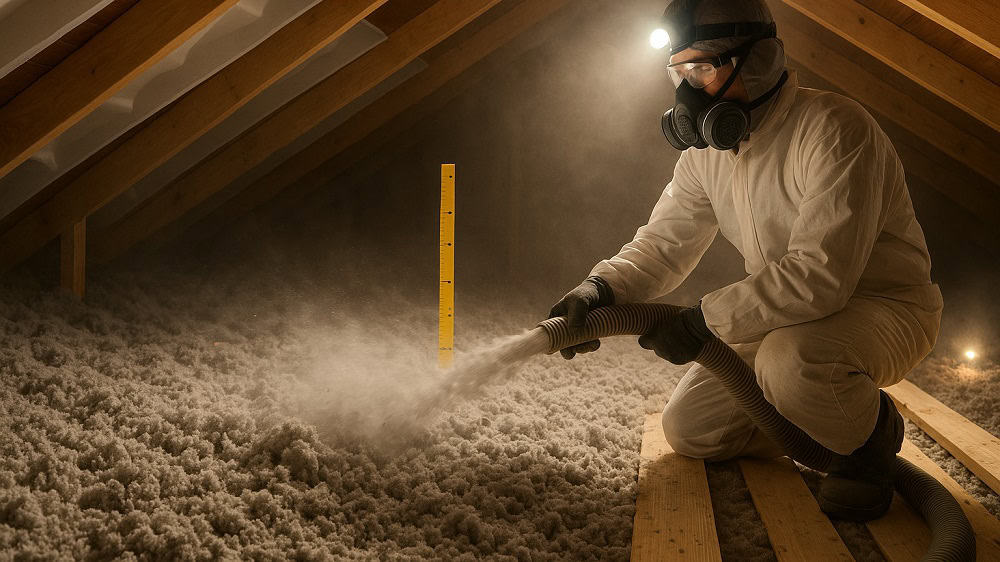

“Air leaks at the ceiling plane let paid-for heat escape in winter and pull hot air in during summer. Pairing attic air-sealing (hatch, top plates, bath-fans, recessed lights) with a blown-in top-up to modern Ontario levels (about R-60 / RSI ≈10.6) creates a continuous thermal blanket that stops those losses. In typical under-insulated homes, this combo delivers meaningful double-digit reductions in heating and cooling use, along with steadier room temperatures and quieter interiors. It also helps keep the roof deck closer to outdoor temperature, which reduces ice-dam risk and protects shingles and gutters. Choose loose-fill cellulose or fiberglass; both perform when installed to the correct depth with proper eave baffles and even coverage. The payoff: shorter furnace/AC runtimes, fewer drafts, and bills that trend down—without major renovation.”
WHY BLOWN‑IN WORKS IN CALEDON’S CLIMATE
Blown‑in insulation excels at filling gaps and irregular cavities that batts miss. The dense layer creates uniform coverage over wires, pipes, can‑lights (properly capped), and framing. That coverage matters most in our local climate where temperature swings drive stack‑effect leakage. The result: fewer drafts, warmer ceilings in winter, cooler rooms in summer, and lower energy bills.
HOW MUCH CAN YOU SAVE?
Industry‑standard modelling shows that air sealing paired with added attic insulation can reduce heating and cooling costs by double digits. For homes that are under‑insulated (many pre‑2000 builds across Caledon fall here), topping up to today’s recommended levels often yields a noticeable drop in monthly bills and more even temperatures across floors.
WHAT “R‑60” MEANS FOR ONTARIO HOMES
In Ontario’s cold‑winter zone, a common attic performance target is roughly R‑60 (RSI ~10.6). That level helps limit heat loss, reduce the risk of ice dams, and improve year‑round comfort. If your attic currently sits around R‑20 to R‑32 (typical in older homes), a blown‑in top‑up is a straightforward path to modern performance without major renovation.
COMPARE MATERIALS: CELLULOSE VS. FIBERGLASS
LOOSE‑FILL CELLULOSE
Cellulose (recycled fibre treated with fire retardants) packs densely and is particularly good at blanketing around obstructions. It offers strong sound dampening and helps resist convective looping in cold attics when installed to spec.
LOOSE‑FILL FIBERGLASS
Fiberglass provides reliable thermal resistance at a lighter density and is a durable, non‑settling option when the correct installed thickness is maintained. Both materials can deliver excellent results when depth, coverage, and ventilation details are correct.

LOCAL MICRO‑CLIMATES: BOLTON, CALEDON EAST, MAYFIELD, PALGRAVE, VALLEYWOOD
Within Caledon, exposure and elevation vary. Homes near open fields (Palgrave and parts of Caledon East) can see stronger winds that amplify infiltration. Valleywood and Mayfield subdivisions often have complex attic geometries (vaults, hips) that benefit from the gap‑filling nature of blown‑in. Bolton’s mix of older stock and additions makes air‑sealing prep especially important before the top‑up.
EARLY ENERGY WINS (AND A SMART NEXT CLICK)
Two moves consistently unlock savings: (1) air‑seal big leaks (attic hatches, top plates, bath fans, recessed lights), and (2) add uniform insulation depth to reach your target R‑value. For broader planning across your home, explore our residential insulation services to see how attic, walls, and basement interact as one envelope.
INSTALLATION: WHAT TO EXPECT FROM A PRO ATTIC TOP‑UP
SITE PREP & AIR‑SEALING
Before any fibres are blown, technicians seal the usual suspects: plumbing penetrations, wiring holes, dropped soffits, and the attic hatch. Baffles are set at eaves to preserve ventilation, and depth markers ensure the final R‑value is achieved uniformly.
BLOWN‑IN APPLICATION
Material is metered from a hopper via hose to blanket the attic. Installers maintain consistent depth across joist bays and around obstacles, preventing thin spots that create hot/cold ceiling patterns. Expect tidy access, dust control, and post‑install depth checks.
RESULTS YOU CAN FEEL
Most homeowners report steadier room temperatures, fewer drafts along baseboards, and quieter interiors within days. Furnace/AC runtimes shorten as the building holds temperature longer; that’s the comfort you notice and the savings you see.
USE CASE: WHEN A TOP‑UP MAKES THE BIGGEST DIFFERENCE
Older Caledon bungalows and split‑levels with R‑20 to R‑32 often gain the most. Another prime case: homes with winter icicles or past ice‑dam issues — signs of ceiling heat loss. A proper blown‑in top‑up, paired with air‑sealing and eave ventilation, reduces melt‑refreeze at the roof edge and protects shingles and gutters.
For adjacent upgrades that compound savings, consider targeted attic insulation upgrades (baffles, hatch weatherstripping, bath‑fan ducting) during the same visit.
WHY CHOOSE FOAMIT FOR BLOWN‑IN?
Local crews, consistent install depth, and clean job sites — it’s why Caledon homeowners trust FOAMIT. We assess your existing R‑value, air‑seal the big leaks, and top up to your performance target so you feel the difference on the next bill.

FAQs: STRAIGHT ANSWERS FOR CALEDON HOMES
HOW MUCH CAN A BLOWN‑IN ATTIC TOP‑UP CUT HEATING & COOLING COSTS LOCALLY?
Under‑insulated attics are common in older Caledon homes. Air‑sealing plus a blown‑in top‑up to modern levels has been shown to deliver meaningful double‑digit reductions in heating and cooling use, alongside comfort gains. Your exact savings depend on starting R‑value, air leakage, and HVAC efficiency.
WHAT R‑VALUE SHOULD I TARGET IF I LIVE IN BOLTON, CALEDON EAST, MAYFIELD, PALGRAVE, OR VALLEYWOOD?
Most local homes benefit from an attic target around R‑60. If you’re starting much lower, you could consider incremental steps, but reaching the full target typically gives the best comfort‑to‑cost payoff.
WILL BLOWN‑IN INSULATION HELP WITH ICE DAMS?
Yes — by lowering ceiling heat loss and keeping roof deck temperatures more uniform. The critical trio is air‑sealing, correct insulation depth, and continuous soffit‑to‑ridge ventilation.
HOW LONG DOES A PROFESSIONAL ATTIC TOP‑UP TAKE?
Most single‑family attics are completed in a few hours, including air‑sealing. Access, existing insulation, and attic complexity (vaults, dormers) influence timing.
CARE & PERFORMANCE TIPS AFTER INSTALL
QUICK CHECKLIST
- Keep storage paths raised so boxes don’t compress insulation.
- Verify bath‑fan ducts are sealed and vent outdoors, not into the attic.
- Seasonally check soffit vents remain clear after windy storms.
- Schedule a re‑check if you add pot lights or new penetrations.
READY TO CUT ENERGY WASTE?
If your Caledon home runs hot‑and‑cold or your bills keep creeping up, it’s time to act. Use our book a Caledon assessment to schedule a quick attic check and estimate with a local pro.